Witnessing joy amid the death: BBC travels to epicentre of Ebola outbreak

 BBC
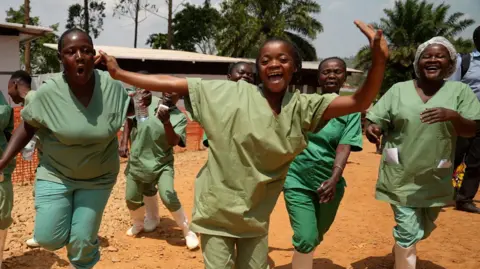
BBCIt is strange to witness singing and dancing in a place which has seen so much death but the successful treatment of an Ebola patient is cause for celebration at a hospital in the north-east of the Democratic Republic of Congo.
Just after midday on Friday, about a dozen healthcare workers in green scrubs sang songs of praise – "grace has been shown to us; grace has been shown to patients" – as they escorted Daniel Kitambala out of the clinic.
Two negative Ebola tests confirmed he was free of the virus after spending about three weeks at the facility.
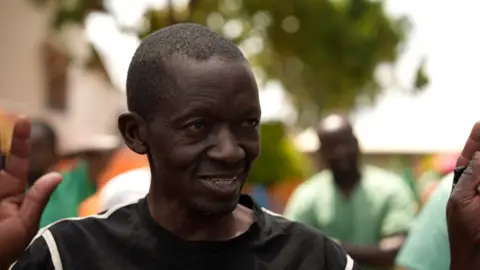
"That disease is terrible. I was feeling very ill [when I came here]. But God is great, I am well now," Kitambala, a devout Christian, told the BBC as the medics continued to cheer.
The 49-year-old, dressed in a black T-shirt and trousers and carrying a black polythene bag with his sterilised belongings, was beaming with joy and relief as he walked between the two lines of orange netting that mark out the path out of the treatment centre.
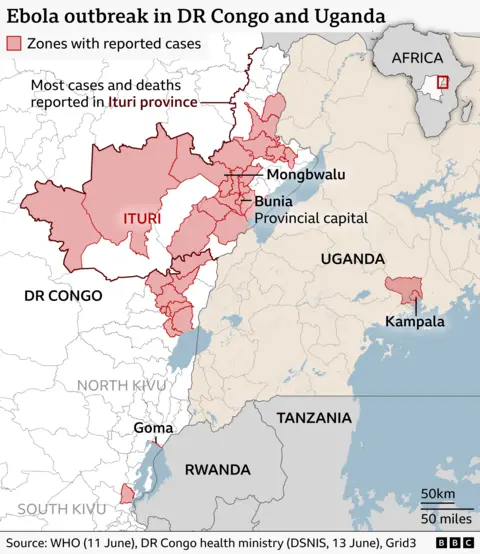
More than 140 people are confirmed to have died from the rare Bundibugyo species of the disease here in Ituri province, the epicentre of the latest outbreak that was first declared just over a month ago.
But this virus, which has killed around one in five of those known to have been infected, could have been spreading undetected for months. The authorities are now battling to get infections under control.
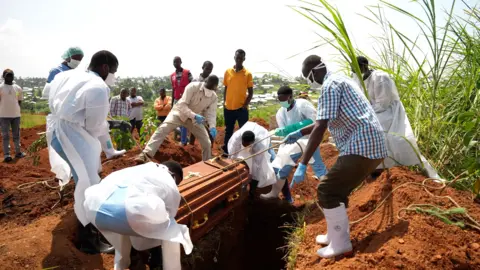
That struggle is in part about overcoming local myths, including that the disease is the result of something known here as the "coffin curse" and that treatment centres are the problem rather than the solution.
But it is possible to survive the virus and the celebrations at the Ebola treatment centre in Mongbwalu were a sign of that.
 Amensisa Negera / BBC
"See… I recovered," the subsistence farmer said as he raised his hands in the air three times in a victory salute and in praise of God.
"People should seek treatment when they fall ill," he said as he turned to thank the healthcare workers behind him who were clapping.
Reflecting on how he was infected, Kitambala said he went to see someone in his community who was unwell and pray for him. Shortly afterwards, he fell ill himself.
The virus spreads from one person to another by contact with infected bodily fluids such as blood or vomit.
When Kitambala first fell ill, like many people in DR Congo, he initially tried traditional medicine. But when his condition deteriorated, he went to hospital.
"We have seen a huge difference in the community since the first patient recovered and returned home," said Dr Richard Lukodu, Mongbwalu hospital's medical director.
"More people are coming here now seeking treatment."
Fifty-five-year-old pastor Deogratias Kasereka became the first Ebola patient to leave the centre a week ago.
Lukodu is optimistic that the recoveries will help build trust in the healthcare system as his hospital has been a target of violence connected to misinformation.
On 21 May, a tent set up to treat Ebola patients in the hospital's grounds was set on fire.
Myths about what medics were doing had been circulating since February – three months before the Ebola outbreak was confirmed – when people started dying in noticeable numbers from an unusual illness.
"The people here had been misled to believe that Ebola ended during previous outbreaks after they burned down the treatment centres," Lukodu said.
During the 2018-2020 outbreak in neighbouring North Kivu province, Ebola treatment centres were attacked and set ablaze multiple times.
 Amensisa Negera / BBC
This is just one of several rumours circulating in the community since people started dying from this disease, said Mongbwalu's mayor, Sesereki Mandro Israel.
Seated inside his blue office in the heart of the town, which has no paved roads, he explained that an incident in early February appeared to have triggered a large number of infections.
"There was a time a family was bringing a body from Bunia for burial here," the mayor said, referring to the provincial capital some two-and-a-half hours away by road.
"But the coffin broke on the way here. The man was buried and the broken coffin burnt."
That led to what became known as "the coffin curse" in the community. The deaths were blamed on the act of burning the coffin.
"The situation was bad. Many people died," he says. "People were dying daily – seven, eight or even 10 people every day."
But things are now changing gradually, he says.
Initial tests on those suspected to have the virus were negative as medical investigators were looking for other more common species of Ebola rather than Bundibugyo.
"We called community leaders to explain the symptoms and encouraged them to refer people with signs of the illness to the treatment centres."
A fortnight ago, the hospital in Mongbwalu got a laboratory and can now return results within a day. Until then, it took more than a week to get results from the nearest testing laboratory in Bunia.
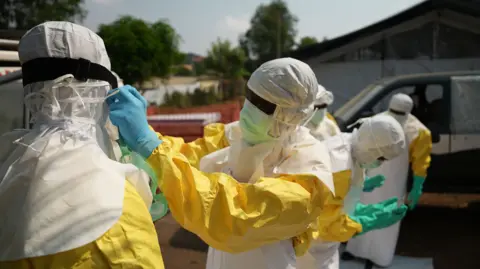
Medics are among those most at risk of infection in every Ebola outbreak and this one is no exception.
"Five health workers have died here and several more who are infected, they are admitted here," said Lukodu.
But improved practices to prevent infection had been put in place since the outbreak was declared, reducing the risk of infection, he added.
 Amensisa Negera / BBC
There is a similar situation in Rwampara, a second town at the heart of this outbreak.
A treatment centre here was set on fire two days after the one in Mongbwalu.
But it has since reopened and late afternoon is visiting time for families to see their loved ones. A wife and her sister are kept waiting as the doctor is checking on the husband. The apprehension is visible.
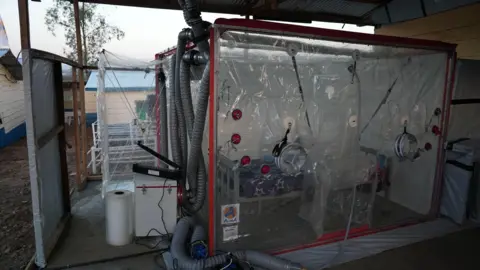
Inside, things are carefully managed to ensure patients do not interact closely with hospital workers and visitors.
Patients with more severe illness are in their own cubicles and only medical teams in full protective equipment are allowed in. There is an open space that patients can access, but anyone coming to see them is separated by a barrier about two metres wide.
Elsewhere, there are large glass screens and curtains where those being treated can also be seen safely.
"I feel very happy. I'm looking forward to going back home," Mireille Gahindo said, speaking from the other side of the glass after two weeks of being here.
She had taken her 11-month-old child to a local hospital after he got a fever and diarrhoea. He was treated but did not improve after two weeks.
When he started bleeding from the mouth she brought him to the treatment centre and she too then tested positive. Both the mother and child are now improving.
She can't wait to rejoin her two older children – aged five and two-and-a-half – and her husband when she gets discharged.
 Amensisa Negera / BBC
"If it was any other infection, I would have discharged her," her doctor said. But with Ebola, each patient has to be tested twice for the infection and obtain negative results before being allowed to go home.
At the entrance to the treatment centre, Eli Asimwe Bawere said he had gone to see his older sister and brother.
His stepmother was also admitted here.
"We have already lost our mother and sister-in-law who was married to my brother who is here. We have mourned a lot. We don't want to mourn any more," he told the BBC.
So many people in Ituri seem to know someone who has died from suspected Ebola. Videos and photographs are circulating on social media showing families who have been affected.
Amid all the desperation and death, every recovery of an Ebola patient brings the community and healthcare workers much needed hope that the outbreak can be controlled.
But much still needs to be done. In order to really stop the virus spreading everyone an infected person has been in contact with needs to be traced in order to see if they've been infected.
Health officials have warned that many of these are still being missed and until they are found, any optimism may be short-lived.
 Getty Images/BBC
Go to BBCAfrica.com for more news from the African continent.
Follow us on Twitter @BBCAfrica, on Facebook at BBC Africa or on Instagram at bbcafrica