Special police team to investigate killing of an anti-migrant leader in South Africa
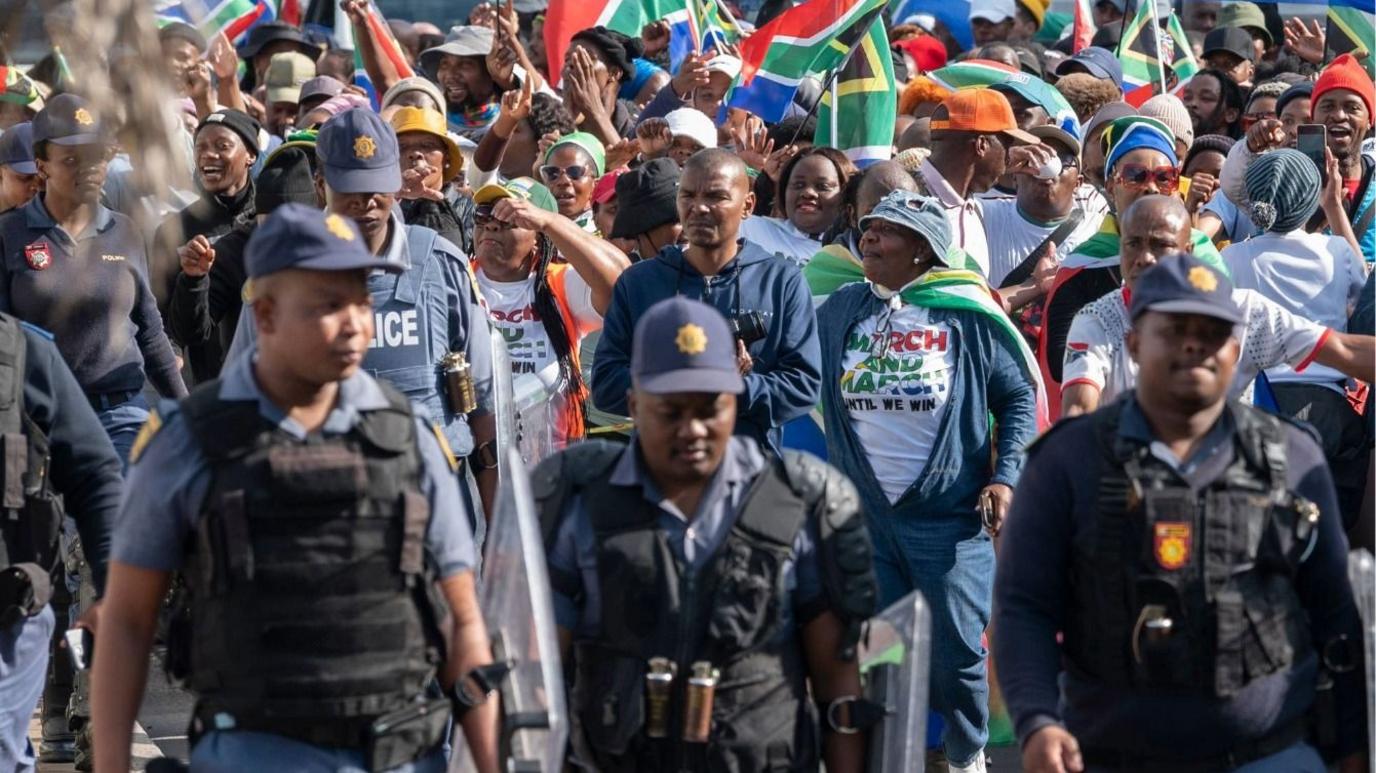 Image source, Gallo Images via Getty Images
Demonstrators had set an unofficial deadline of 30 June for all undocumented migrants to leave South Africa
-
Published54 minutes ago
A special police team has begun investigating the killing of a provincial leader of an anti-migrant group in South Africa.
Police confirmed that Andile Mvuyelwa Somgxada, the Gauteng province leader of March and March, was shot outside his home east of Johannesburg earlier this month and died several days later in hospital.
"It's a retaliation," March and March spokesperson Sandile Dube told the BBC, explaining how the movement believed he was targeted because of its campaign to get undocumented migrants to leave the country.
He said other leaders of March and March, which has been organising anti-migrant demonstrations across the country, had recently received warnings or death threats.
"This seems like an orchestrated hitman type of killing," Dube told the BBC's Newsday programme, urging the authorities to get to the bottom of the matter and the intimidation the organisation was facing.
Acting police chief Lt Gen Puleng Dimpane has announced a multidisciplinary team to investigate the shooting, which he said underscored the seriousness with which the service was treating the case.
"We are committed to conducting a thorough investigation to establish the circumstances surrounding this murder and to ensure accountability," he said in statement on Tuesday evening.
 Image source, March and March
Andile Mvuyelwa Somgxada was shot in the driveway of his home earlier in July
Immigration – especially undocumented migration – has become a highly contentious political issue in South Africa, with protesters accusing them of placing pressure on public services, as well as being involved in crime.
March and March had set an unofficial deadline of 30 June for all migrants without papers to leave the country. Protesters have promised to stage weekly marches until their demands are met.
The South African government has said more than 53,000 foreign nationals have been deported or repatriated since it launched a "migration management" campaign five weeks ago.
Xenophobia has long been an issue in South Africa, which is Africa's wealthiest nation and has long attracted migrants searching for better economic opportunities.
It has sometimes led to violence – and this current round of demonstrations has seen violence, intimidation and looting.
On Tuesday, five people were arrested in Limpopo province for allegedly impersonating immigration officers and unlawfully demanding foreign nationals leave the country.
The police said the incident involved a Nigerian national – who was legally in South Africa – being intimidated and forced to close his business by the suspects.
Lt Gen Dimpane issued a "stern warning" to those who "continue to intimidate, harass and perpetrate violence against foreign nationals".
"The law applies equally to everyone," he said.
"No individual or group has the authority to conduct immigration inspections, verify legal status, or remove people from communities."
When questioned on how some foreign nationals had been treated by anti-migrant protesters, Dube said March and March rejected "any form of violence – we reject any form of anti-law".
There are more than three million documented foreign nationals in South Africa, according to official figures, which does not account for those in the country illegally.
Several countries, including Ghana, Kenya, Malawi, Nigeria and Uganda, have been organising flights or buses for their citizens to return home in recent weeks.
-
'We have to prioritise South Africans': Anti-migrant movement blocks foreigners from healthcare
-
Published18 October 2025
-
-
The king's speech – and why it has foreigners in South Africa worried
-
Published1 February
-

Go to BBCAfrica.com, external for more news from the African continent.
Follow us on Twitter @BBCAfrica, external, on Facebook at BBC Africa, external or on Instagram at bbcafrica, external