Shorts, strappy tops and sandals: Can my boss tell me what to wear in summer?
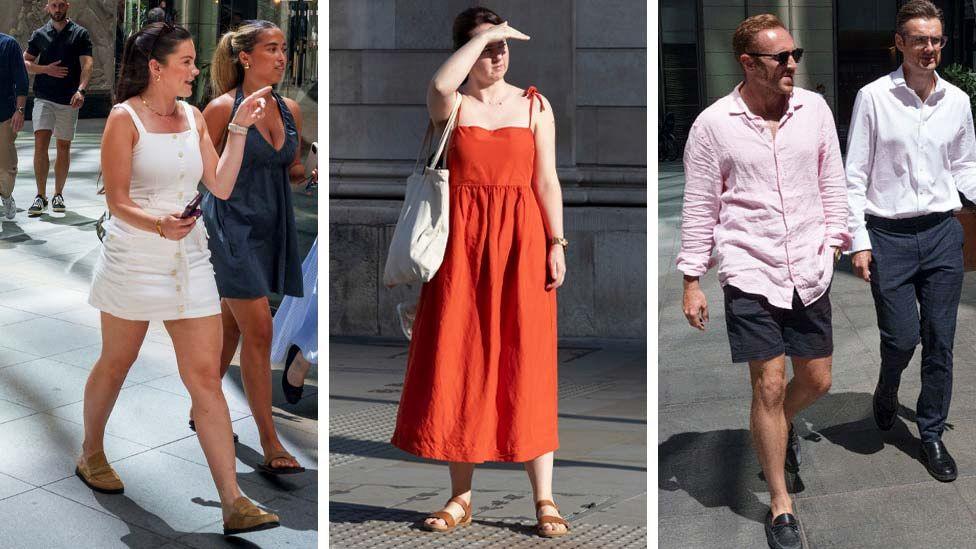 Image source, Getty Images
-
Published9 minutes ago
Yet another summer heatwave could be on the way to make your commute sweaty and your workplace stuffy.
What to wear to work in the summer can be a surprisingly difficult decision. Shorts, strappy tops and sandals may keep you cool – but will they be judged too casual, revealing or unprofessional?
There's a bare-legged backlash in Tokyo where officials encouraged men to swap suits for shorts at work, prompting complaints about hairy legs in the office.
So what is acceptable to wear to work, how can you successfully style your summer wardrobe and can your boss tell you what you can and can't wear?
Shorts
To play this video you need to enable JavaScript in your browser.
This video can not be played
Should men be allowed to wear shorts in the office?
Conor, who works in media, has regularly worn shorts to the office during the recent hot weather. "Who gives a monkey's what you wear?" he says.
"If you're able to do your job safely, professionally and appropriately, there's a lot to be said for letting people be comfortable."
And many seem to agree – a recent poll by market research firm Ipsos found 62% of adults thought it was acceptable for men to wear shorts to work in hot weather, while 63% said the same for women.
But we aren't talking short-shorts or denim hot pants fashion designer Amanda Wakeley points out: "If you're asking yourself whether they're too short, they probably are".
She says shorts are "the trickiest item to get right in a professional environment" and recommends tailored, longer shorts paired with a crisp shirt or lightweight blazer for both men and women.
Stylist Clare Chambers agrees shorts should sit around the kneecap for both men and women. For men, she recommends tailored chino-style shorts with an untucked T-shirt or shirt.
Sandals
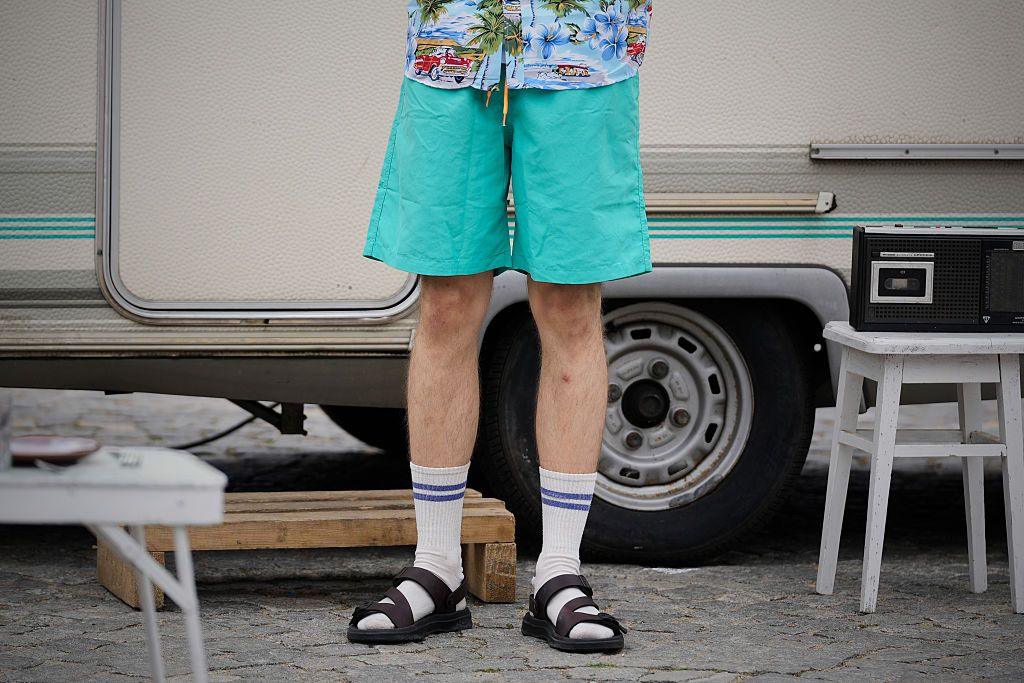 Image source, Getty Images
Socks and sandals are a combo hard to pull off at the best of times, let alone in the office
Wakeley describes flip-flops as one of the few definite "no" items in most offices. "They instantly signal leisure rather than professionalism and can make even the most polished outfit feel underdressed," she says.
Chambers agrees, and says even during the hottest weather, woven flats are a better option because they are breathable while still covering the foot.
Almost two-thirds of people questioned by Ipsos said they were unacceptable for men in the workplace, while 58% said the same for women.
Sandals, however, are a slightly different matter as Wakeley says refined leather sandals can be entirely acceptable in many offices, provided they are clean and well maintained.
The difference, she says, is whether they look like part of a considered outfit or something that would normally be worn around a swimming pool.
She adds that while socks and sandals have become a viral fashion trend "it's important to consider whether a trend aligns with the image you want to communicate professionally".
"This combination can read as highly casual and youthful, which may unintentionally detract from giving you a credible and authoritative presence."
Strappy tops
 Image source, Getty Images
Public opinion is divided over bare shoulders at work
Some 40% of adults considered tank tops or vest tops acceptable for women at work, compared with only 24% who said the same for men, according to Ipsos.
Natasia, a teacher in London, says at a previous school she and other staff had been summoned "regularly in the summer months to tell us off about our outfits."
She says she was also told to cover up her tattoos. "It should be OK to have your arms out at work especially when it's hot," she says.
Wakeley says a well-cut camisole or strappy top can work when worn beneath a linen overshirt, lightweight jacket or tailored co-ord. On its own, however, it may feel too informal.
Chambers says if you're wearing a strappy top "you must wear a strapless bra as it utterly kills an outfit when you can see bra straps".
She explains that thicker straps are a safer option where the dress code is unclear and recommends satin camisoles as a more polished alternative to basic cotton vests.
She adds that while bandeau tops are "such an on-trend look this summer, they are a no-go for work".
"The constant need to keep fiddling to pull them up displays an uncomfortable and unconfident demeanour," she says.
How to style summer clothes at work
 Image source, Getty Images
The answer to dressing for the heat isn't necessarily to wear less, but to choose clothes more carefully
Wakeley and Chambers both say that you don't need to lose your personal style when dressing for the office and you can still inject plenty of personality while following a dress code. Here are their top tips on how to style summer clothes for the office.
Can your employer tell you what to wear?
Climate change is expected to bring more severe, frequent and longer-lasting heatwaves in UK summers in the coming years.
Employers are allowed to set standards around clothing and appearance, particularly where there are legitimate reasons such as safety, branding or maintaining a professional image.
But employment lawyer Sarah Tahamtani says dress codes should be "reasonable, proportionate and capable of justification".
"During extreme heat, employers should consider whether existing requirements remain practical and whether greater flexibility can be introduced."
They must also consider employees with disabilities, medical conditions or other vulnerabilities that may be worsened by high temperatures.
An employee who believes a request is unreasonable or inconsistently applied should first raise the issue with a manager or HR and explain how the rule is affecting their comfort or ability to work safely.
Related topics
-
-
Published9 July

-