Israel strikes southern Lebanon but partial truce with Hezbollah appears to hold
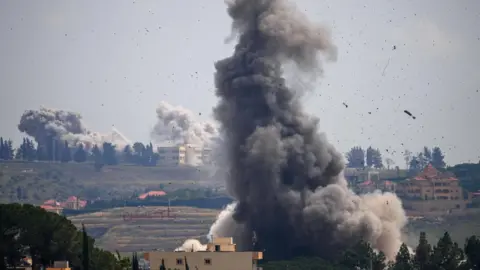
Israel continued its attacks in southern Lebanon on Tuesday, but did not strike Beirut following a partial ceasefire agreement with the Iran-backed armed group Hezbollah.
Lebanon said that, under an agreement announced by US President Donald Trump late on Monday, Israeli forces would not bomb the capital in exchange for Hezbollah not attacking Israel.
It came after Iran said Israeli action in Lebanon jeopardised talks on a deal to end its war with the US.
Following the ceasefire announcement, the Israeli military said it had intercepted two projectiles fired into northern Israel. Hezbollah said it had attacked Israeli forces in southern Lebanon, where officials reported deadly Israeli strikes.
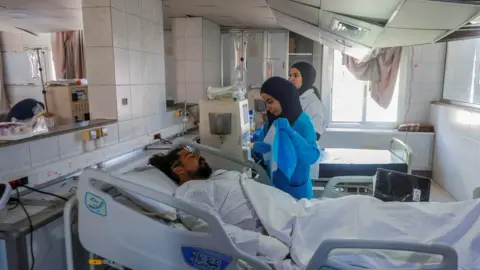
The Lebanese health ministry also said four people had been killed and 127 injured when Israeli air strikes hit buildings next to Jabal Amel hospital in the city of Tyre on Monday afternoon. Thirty-nine hospital staff were among the injured, with four in a critical condition.
What remained in the area outside the hospital on Tuesday was utter devastation.
Chunks of concrete and twisted metal were scattered across the area. The beeping of damaged cars and the crackle of downed electrical wires echoed through streets that were otherwise eerily quiet.
Apart from a handful of local journalists, almost no-one was outside.
A woman stood in tears, staring at an apartment building that was half gone.
"I live there," she said, pointing at the wreckage, before adding: "Used to."
Dr Wael Mroueh, the hospital's director, had spent the evening dealing with the aftermath.
"We were working with patients and displaced people. Business was as usual, and suddenly, 'boom'," he said. "It happened without any prior warning. Pictures speak volumes."
He also denied that there was a military target in the vicinity.
"The Israeli enemy targets journalists, ambulance workers, medical staff. It makes no difference, and all it wants is to kick us out of our country," he said.

 Reuters
Inside the hospital, corridors were littered with broken glass. Ceiling panels had collapsed onto the floors. A row of incubators stood cracked and damaged by the force of the blast.
Just four hours earlier, baby Fares had been born in the maternity ward. He lay swaddled in a blue furry blanket and asleep, while his mother recovered nearby.
His grandmother, Amal, proudly showed him off.
"It's true life is very hard, but we need to bear it," she said, gazing down at her grandson. "This is his country and land, and he [Fares] needs to defend it. This is a responsibility."
The Israeli military said it struck "Hezbollah terrorist infrastructure" in the area.
It acknowledged that the attack caused damage to the hospital but emphasised that it "was not targeted". It also accused Hezbollah of embedding itself within civilian infrastructure and population centres, without providing evidence.
The Lebanese health ministry says 128 paramedics and healthcare workers have been killed 159 attacks on ambulances and medical facilities over the past three months.
 Reuters
On Tuesday morning, Lebanon's civil defence agency said another Israeli strike hit its centre in Kfar Sir, in Nabatieh district, causing damage but no casualties. It shared photos on X that showed twisted metal beams hanging from the ceiling and debris covering the floor.
A dentist from the nearby Christian village of Qlayaa was killed along with his daughter and son in a drone strike on the road between the towns of Marjayoun and Nabatieh, Lebanon's state-run National News Agency reported.
The Israeli military issued a fresh evacuation order for Nabatieh town on Tuesday afternoon. It warned residents that it was "compelled to act forcefully" against Hezbollah there because of the group's "violation of the ceasefire agreement".
It did not give further details, but the Israeli foreign ministry said Hezbollah had violated Monday's declarations by launching "multiple missile and drone attacks from Lebanon against Israeli communities".
Hezbollah's military wing said its fighters had targeted Israeli tanks and troops in the southern Lebanese towns of Haddatha, Bayada and Zawtar al-Sharqiya with drones, missiles and shells. It did not mention any cross-border attacks.
Lebanon was drawn into the war between the US, Israel and Iran on 2 March, when Hezbollah launched rockets into Israel in retaliation for an Israeli strike that killed Iran's supreme leader.
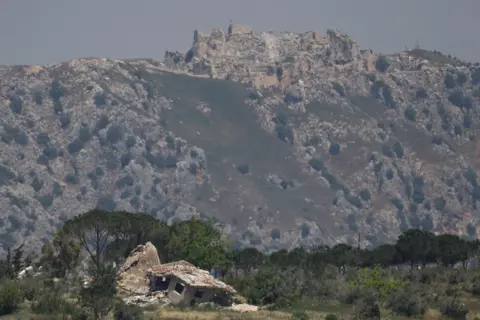
Israel responded with an air campaign across Lebanon and a ground invasion in the south, which has been escalating in recent weeks.
At least 3,468 people have been killed in Lebanon since the start of the war, according to the country's health ministry. Its figures do not distinguish between combatants and civilians.
The UN says more than one million people have also registered themselves as displaced in Lebanon, where Israeli evacuation orders cover more than an eighth of the country.
Israel says 25 of its soldiers and four Israeli civilians have been killed on both sides of the border during the war.
 Reuters
On Monday evening, Lebanon's embassy in Washington said its government had received confirmation of Hezbollah's acceptance of a US-backed proposal for a partial ceasefire, following a call between President Joseph Aoun and US Secretary of State Marco Rubio.
"Under the proposed arrangement, Israel will not launch a broad offensive on Beirut in exchange for Hezbollah refraining from launching attacks against Israel, creating an opportunity for the ceasefire framework to be expanded to encompass all Lebanese territory," a statement said.
Trump subsequently informed Lebanese ambassador Nada Moawad that he had secured Israeli Prime Minister Benjamin Netanyahu's approval, and Aoun then relayed the outcome to Hezbollah, it added.
Later, Trump wrote on Truth Social that he had spoken to Netanyahu and representatives of Hezbollah's leaders. "They agreed to stop shooting at Israel, and its soldiers. Likewise, Israel agreed to stop shooting at them," he added.
The Israeli prime minister then put out a statement saying he had told Trump that "if Hezbollah does not stop firing at our cities and citizens, Israel will strike terrorist targets in Beirut". He also said that the Israeli military would "continue to operate as planned in southern Lebanon".
Hezbollah has not publicly commented on the agreement.
However, senior Hezbollah lawmaker Hassan Fadlallah said the group's Al-Manar TV that it would not support a "one-sided" ceasefire. He called for a comprehensive ceasefire as a prelude to the withdrawal of Israeli troops from southern Lebanon.
Parliamentary Speaker Nabih Berri, a longtime intermediary between Hezbollah and the US, also told the New York Times that the group would accept a "real ceasefire".
Further negotiations between Israeli and Lebanese diplomats are scheduled for Tuesday and Wednesday in Washington.
The diplomatic push came after Netanyahu announced that he had ordered Israeli strikes on Beirut's southern suburbs, a Hezbollah stronghold, in response to rocket and drone attacks on Israeli civilians and other violations of the April ceasefire agreement.
US news outlet Axios cited two US officials as saying that Trump later "lashed out at" Netanyahu in "an expletive-laden call", and told him not to follow through on his plan.
Some Israeli politicians criticised Netanyahu for accepting Trump's demand not to attack Beirut.
"Now is the time to tell… our friend 'no'," said far-right National Security Minister Itamar Ben Gvir. The opposition leader, Yair Lapid, said Israel had become a "client state in full".
There has been no comment from the prime minister's office.
Axios suggested that Trump's anger was driven by his concern that the Israeli escalation was threatening negotiations on a deal to end the US-Israeli war with Iran.
Netanyahu's threat prompted a slew of warnings from Iranian officials, with Foreign Minister Abbas Araghchi saying the US-Iran truce was "unequivocally a ceasefire on all fronts, including in Lebanon" and that "its violation on one front is a violation of the ceasefire on all fronts".
Separately, Iran's hard-line Tasnim news agency reported that Tehran could suspend indirect negotiations with the US over Israeli military actions in Lebanon.