This farmer wanted to quit the cocaine industry – he couldn't
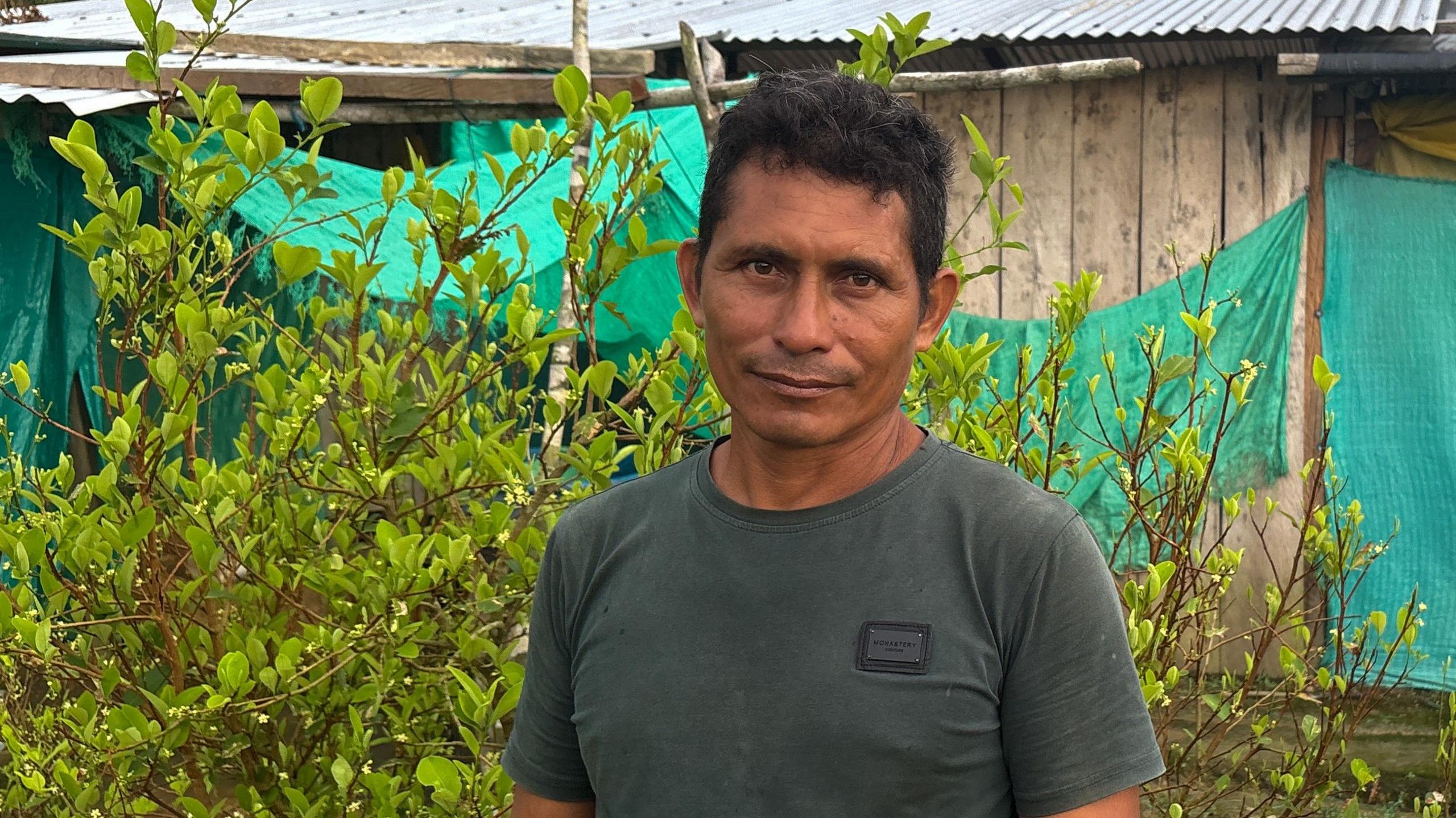
Coca farmer Perea says he has not had the financial support required to stop growing the crop
-
Published16 minutes ago
When Perea stopped growing coca – the raw material used to make cocaine – he vowed never to plant it again.
He uprooted the green bushes on his small farm in a remote corner of the province of Meta in Colombia, reachable only by river, and replaced them with legal crops like cassava and plantain.
Perea was one of thousands who joined a government-run crop substitution programme aimed at helping farmers abandon coca.
But much of the promised assistance never arrived, and a lack of roads and recurring floods made it difficult to sell his produce.
In 2024, disillusioned, he began planting coca again.
"It's a tragedy," says Perea. "But when you have children and no work, what choice do you have? If no help ever arrives, you go back to growing it."
The coca leaf is an ancestral crop traditionally used by indigenous communities in teas and medicines. But today most of it is processed into cocaine. An estimated 70% of the global supply of the illegal drug comes from Colombia.
"Coca has some major advantages over other crops," says Lucas Marín Llanes, a Colombian researcher who focuses on the coca economy and substitution strategies. "Harvests are quick – farmers can get three or four a year – it's easier to transport, and farmers know what price they'll get."
Research Marín has worked on shows coca cultivation can also boost local economies, increasing municipal GDP by as much as 10% in some areas between 2014 and 2019.
Substitution programmes were designed to help Colombian coca farmers move away from the crop and build legal livelihoods.
Yet today the planting of coca is at record levels at more than 250,000 hectares – and many Colombians in substitution programmes say they have been let down.
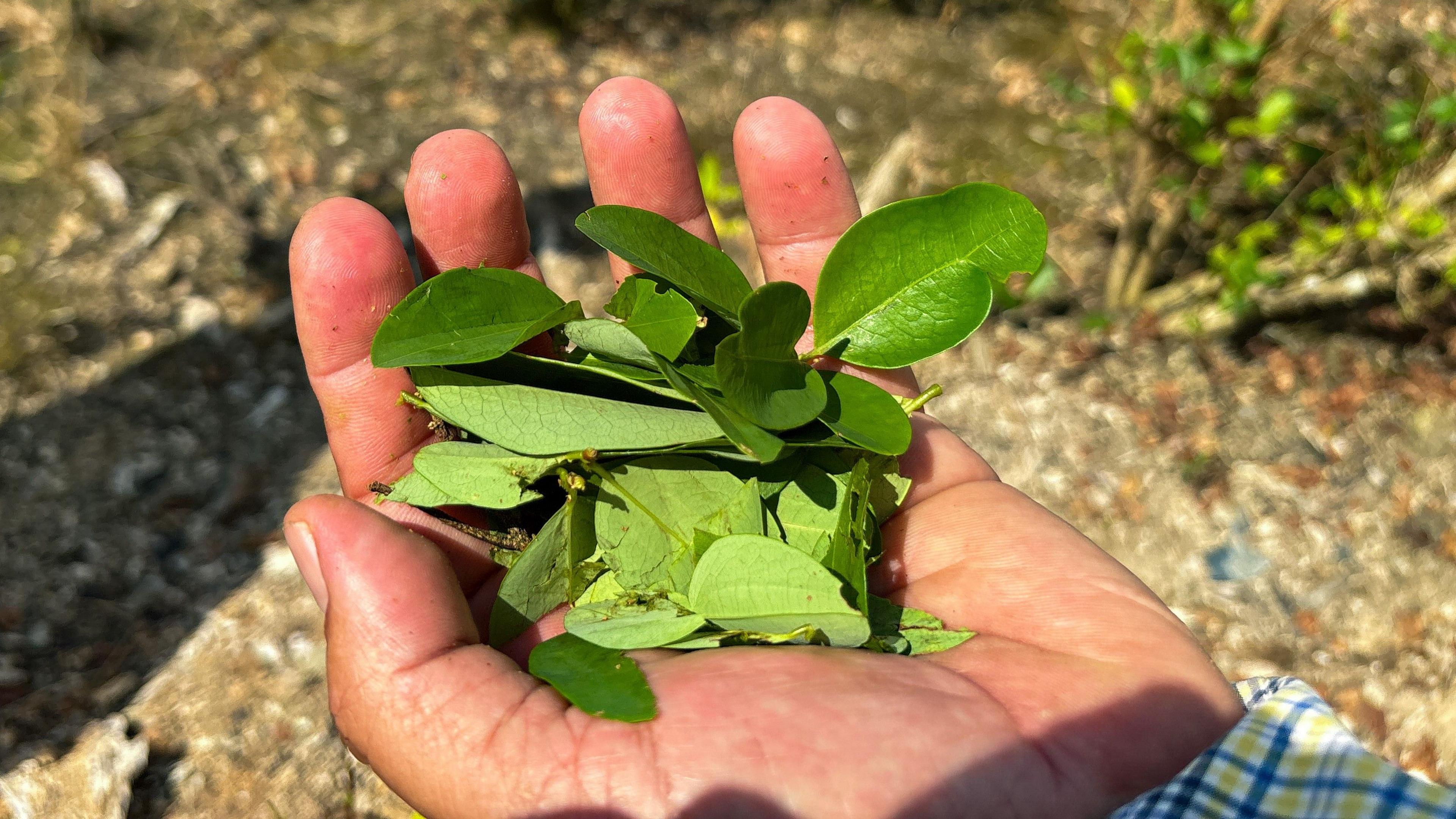
Coca leaves, which can be processed into the drug cocaine
Elena Hernández moved to the coca-growing region of Guaviare during the boom of the 1990s, lured by better pay.
"There was more money back then – you could see it everywhere," she says. "I managed to save and buy a small house."
But the coca industry also brought violence and insecurity. Armed groups fought for control, while the government tried to curb production through manual eradication, aerial fumigation and arrests.
These efforts cut off families' incomes but failed to stem cultivation.
So when a nationwide substitution programme was introduced by the then government in 2017, Hernández was eager to sign up, joining around 100,000 families who were promised financial support in return for moving away from coca.
Each household was due to get 36m Colombian pesos ($11,000; £8,000), spread over a two-year period.
"The way it was presented to us, it seemed very promising for the development of our territory," says Hernández.
The programme, known as the National Comprehensive Programme for the Substitution of Illicit Crops (PNIS), was born out of the 2016 peace deal between the government and Colombia's largest guerrilla group, Farc.
In exchange for uprooting their coca plants, farmers would also get technical support, including from agronomists, and advice on soil management.
While substitution programmes had existed before, they remained limited in scale. PNIS was the most ambitious attempt to date – and at first appeared to be working.
In parts of southern Meta and Guaviare, coca fields were replaced by lemon trees, banana crops and small livestock farms. Many farmers, like Hernández, stayed away from coca.
Yet that does not mean they consider it a success.
"The government wasn't very committed to us farmers. We were treated badly," explains Hernández, pointing to problems that emerged early on.
Payments were delayed, and technical support frequently failed to materialise. Weak state presence in rural areas and poor coordination between agencies meant support often did not reach communities.
Momentum behind the programme weakened as political priorities shifted. Iván Duque, who became Colombia's president in 2018, refocused the government's approach on eradication and security strategies.
By the time current President Gustavo Petro took office in 2022, PNIS was behind schedule and struggling to reach communities.
But some farmers did report improvements. For Doralba Bejarano, from Puerto Rico in southern Meta, her situation improved as stalled support began to arrive.
"Before the programme we were terrified," she says. "We had to hide the coca paste because the police, the military, would put us in jail." Coca paste is a more concentrated form of coca used to produce cocaine, allowing growers to earn more than selling raw leaves.
Now, she says, she has peace of mind: "I go wherever I want. I have no reason to hide."
She says many in her community are now receiving government support to promote and sell their non-coca crops and other foodstuffs.

Doralba Bejarano says she has peace of mind after giving up growing coca leaves for the cocaine industry.
The challenges facing substitution are also driven by forces beyond Colombia's borders – continuing huge appetite for cocaine in the US and Europe, as well as newer markets elsewhere.
"Right now there is expanding demand, and so there will be supply to meet that," says Michael Weintraub, co-director of the Centre for the Study of Security and Drugs at the University of the Andes, which is based in Colombia's capital Bogota. "That means Colombia will grow coca for the foreseeable future."
Weintraub also describes the security context in Colombia as "fragile" – making it difficult for substitution programmes to operate effectively in many rural areas.
Although the 2016 peace deal led to the disbanding of large parts of Farc, other armed groups have moved in to fill the vacuum, and often control trafficking routes and the local economies.
The current government has sought to address this through its "Total Peace" policy, by which it holds peace negotiations with all the various armed and criminal gangs. But analysts say progress has been limited.
Last year, the government began rolling out RenHacemos – a substitution programme aimed at building on PNIS while addressing its shortcomings – in pilot areas.
While farmers will still get financial support, the programme also focuses on diversifying local economies beyond crop replacement. Wider assistance will include road improvements, access to university education, digital connectivity and better housing.
"Coca is a business," says Gloria Miranda, director of the government agency in charge of illicit crop substitution in Colombia.
"It's a criminal enterprise, but it functions like any other business. RedHacemos aims to replace not only the coca plant, but the entire economy surrounding it – from processing and agro-industry to transport and logistics."
Yet for many analysts, questions remain over whether such approaches can deliver lasting change. Llanes says the continuing growth of coca cultivation shows that repeated interventions haven't worked.
Perea is sceptical that government support to move away from coca will come anytime soon to him and his neighbours.
"The state has completely abandoned us," he says, standing amid the coca plants that surround his weathered wooden shack. "We live day to day, sometimes even running out of food."
For now, he says, he will continue to grow coca – not because he is a criminal but because, he says, it is his only option. "We are not the drug traffickers – if I was, I wouldn't be living like I do."
Related topics
Read more global business stories
-
-
Published9 July

-
-
-
Published7 days ago

-
-
-
Published18 June

-